New York, USA, July 21, 2026 (GLOBE NEWSWIRE) -- PD-1 and PD-L1 Inhibitors Clinical Trial Pipeline Analysis Demonstrates 180+ Key Companies on the Horizon Expected to Transform the Oncology Space | DelveInsight
The PD-1 and PD-L1 inhibitors competitive landscape report delivers important insights into approved as well as ongoing research of 200+ pipeline PD-1 and PD-L1 inhibitor drugs, clinical strategies, upcoming therapeutics, and commercial analysis.
DelveInsight’s PD-1 and PD-L1 Inhibitors Competitive Landscape 2026 report provides comprehensive global coverage of approved and pipeline PD-1 and PD-L1 inhibitors across various stages of clinical development. The report offers an in-depth analysis of key trends, emerging therapies, and competitive landscape dynamics, highlighting the strategies of major pharmaceutical companies to advance the pipeline and capitalize on future growth opportunities. In addition, it includes critical insights into clinical trial benchmarking, partnering and licensing activities, and regulatory pathways involving the FDA and EMA, enabling stakeholders to make informed decisions and optimize development strategies within the PD-1 and PD-L1 inhibitors domain.
Key Takeaways from the PD-1 and PD-L1 Inhibitors Pipeline Report
- DelveInsight’s PD-1 and PD-L1 inhibitors competitive report presents a robust market with over 180 active players developing more than 200 pipeline PD-1 and PD-L1 Inhibitors.
- Key PD-1 and PD-L1 inhibitors companies, such as Merck, Roche, GSK, Innovent Biologics, Astrazeneca, EQRx, CStone Pharmaceuticals, Pfizer, Agenus, Incyte Corporation, Suzhou Zelgen Biopharmaceuticals, Shanghai Junshi Biosciences, Eli Lilly and Company, Sichuan Huiyu Pharmaceutical, Vicero, Rophibio, Shanghai Henlius Biotech, Westlake Therapeutics, Phio Pharmaceuticals, Suzhou Forlong Biotechnology, Aligos Therapeutics, AIM ImmunoTech Inc and others, are evaluating new PD-1 and PD-L1 inhibitors to improve the treatment landscape.
- Promising pipeline PD-1 and PD-L1 inhibitors, such as IBI 363, Rilvegostomig, Sugemalimab, Sasanlimab, Balstilimab, INCB 099280, ZG005, Toripalimab, Sintilimab, HY 0007, VCR 045, RBS-003 biosimilar, Serplulimab, WTX 212C, PH 762, FL 116, ALG 072571, MK-1084, Ampligen (rintatolimod) and others, are under different phases of PD-1 and PD-L1 inhibitors clinical trials.
- Approximately 15+ PD-1 and PD-L1 inhibitor drugs are in the late stage of development, whereas 30+ drugs are in the mid and early stages of development.
- Key indications for PD-1 and PD-L1 inhibitors under development include Non-small cell lung cancer, Adenocarcinoma, Biliary cancer, Endometrial cancer, Bladder cancer, Biliary cancer, Liver cancer, Squamous cell cancer, Glioma, and others.
Request a sample and discover which US cancer centers or hospital systems are known for offering the latest PD-1 and PD-L1 inhibitor therapies for solid tumors @ https://www.delveinsight.com/report-store/pd-1-and-pd-l1-inhibitors-competitive-landscape
What are PD-1 and PD-L1 Inhibitors?
Programmed cell death protein 1 (PD-1) and programmed death-ligand 1 (PD-L1) inhibitors are a class of immune checkpoint inhibitors that enhance the body's immune response against cancer. PD-1 is a receptor expressed on activated T cells, while PD-L1 is a ligand commonly found on tumor cells and immune cells within the tumor microenvironment. The interaction between PD-1 and PD-L1 acts as a natural immune brake, suppressing T-cell activity and allowing cancer cells to evade immune surveillance. PD-1 inhibitors, such as nivolumab and pembrolizumab, block the PD-1 receptor, whereas PD-L1 inhibitors, such as atezolizumab, durvalumab, and avelumab, target the PD-L1 ligand. By disrupting this signaling pathway, these therapies restore T-cell function, promote anti-tumor immune responses, and have demonstrated significant clinical benefits across multiple malignancies, including lung cancer, melanoma, renal cell carcinoma, bladder cancer, and several other solid tumors and hematologic cancers.
To know more about difference between PD-1 and PD-L1 inhibitors, visit @ PD-1 and PD-L1 Inhibitors List
FDA-Approved PD-1 and PD-L1 Inhibitors Drug Profile Analysis
KEYTRUDA: Merck
Pembrolizumab, marketed as KEYTRUDA, is a humanized monoclonal antibody that targets the programmed cell death protein-1 (PD-1) receptor. By inhibiting the interaction of PD-1 with its ligands, PD-L1 and PD-L2, pembrolizumab restores immune system activity and enhances anti-tumor immune responses. It is an IgG4 kappa immunoglobulin with a molecular weight of approximately 149 kDa. Keytruda has been approved for the treatment of multiple malignancies, including advanced melanoma, non-small cell lung cancer (NSCLC), head and neck squamous cell carcinoma, classical Hodgkin lymphoma, primary mediastinal large B-cell lymphoma (PMBCL), small cell lung cancer (SCLC), gastric cancer, esophageal cancer, cervical cancer, hepatocellular carcinoma, Merkel cell carcinoma, renal cell carcinoma, endometrial carcinoma, advanced urothelial bladder cancer, as well as tumors characterized by high microsatellite instability (MSI-H).
JEMPERLI: GSK
JEMPERLI (dostarlimab), developed by GSK, is a humanized monoclonal antibody targeting the programmed death receptor-1 (PD-1). By inhibiting the PD-1 signaling pathway, it helps restore and strengthen T-cell-driven immune responses against cancer cells. The therapy has been approved for the treatment of advanced or recurrent endometrial cancer, either as a standalone treatment or in combination with chemotherapy, and is also authorized for select mismatch repair-deficient (dMMR) solid tumors. In addition, GSK continues to investigate JEMPERLI in a broad range of malignancies, including colorectal, lung, and gynecologic cancers.
Find out more about which pd-1/pd-l1 inhibitor dominates market share in CSCC: LIBTAYO, KEYTRUDA, or TECENTRIQ? @ PD-1 Inhibitor Medication Drug
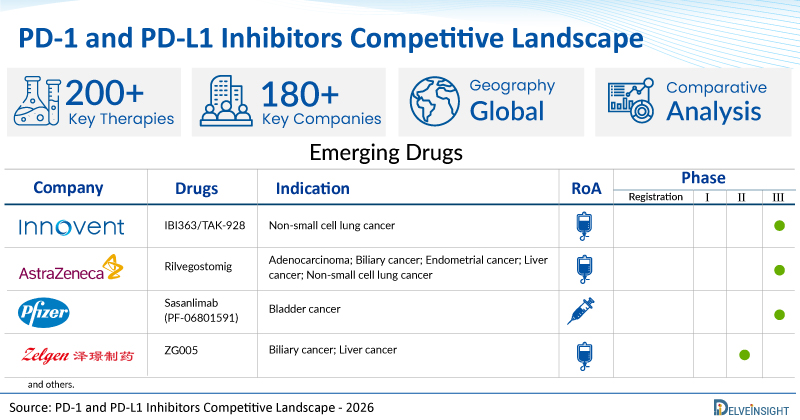
A snapshot of the Pipeline PD-1 and PD-L1 Inhibitors mentioned in the report:
| Drugs | Company | Phase | Indication | RoA |
| IBI363/TAK-928 | Innovent | III | Non-small cell lung cancer | IV infusion |
| Rilvegostomig | AstraZeneca | III | Adenocarcinoma; Biliary cancer; Endometrial cancer; Liver cancer; Non-small cell lung cancer | IV |
| Sasanlimab (PF-06801591) | Pfizer | III | Bladder cancer | SC |
| ZG005 | Suzhou Zelgen Biopharmaceuticals | II | Biliary cancer; Liver cancer | IV |
| INCB 099280 | Incyte Corporation | II | Solid tumors; Squamous cell cancer | Oral |
| C5252 | ImmVira Pharma | I/II | Intracranial Tumor and malignant glioma | Intratumoral injection |
| LVGN3616 | Lyvgen Biopharma | I | Cancer; Solid tumors | IV |
| XTX501 | Xilio Therapeutics | Preclinical | Cancer | IV |
Learn more about the most effective PD-1 inhibitor strategies across tumor types @ PD-1 and PD-L1 Inhibitors Clinical Trials
As per Stuti Mahajan, consulting manager at DelveInsight, PD-1 and PD-L1 inhibitors have transformed the oncology landscape by delivering durable responses across multiple tumor types and becoming a cornerstone of modern cancer immunotherapy. Continued expansion into earlier treatment lines, combination regimens, and biomarker-driven patient selection is expected to sustain market growth. However, increasing competition from next-generation immunotherapies, bispecific antibodies, and cell therapies may intensify differentiation challenges for established PD-1/PD-L1 agents.
Recent Developments in the PD-1 and PD-L1 Inhibitors Treatment Space
- In May 2026, Merck announced that calderasib (MK-1084), an investigational oral specific KRAS G12C inhibitor, in combination with KEYTRUDA® (pembrolizumab), Merck’s anti-PD-1 therapy, has been granted Breakthrough Therapy designation by the U.S. Food and Drug Administration (FDA) for the first-line treatment of patients with advanced or metastatic non-small cell lung cancer (NSCLC) with KRAS G12C-mutation and expressing PD-L1 (tumor proportion score [TPS] ≥1%). This is the first Breakthrough Therapy designation for calderasib and was supported by positive data from the Phase I KANDLELIT-001 trial.
- In May 2026, Innovent Biologics, Inc. announced the preliminary results from a PoC clinical study of its global first-in-class PD-1/IL-2α-bias bispecific fusion protein IBI363/TAK928 plus chemotherapy in the first-line treatment of advanced non-small cell lung cancer (NSCLC). The detailed data were presented at the 2026 American Society of Clinical Oncology (ASCO) Annual Meeting.
- In May 2026, AstraZeneca and Daiichi Sankyo’s Datroway (datopotamab deruxtecan) was approved in the US for the treatment of adult patients with unresectable or metastatic triple-negative breast cancer (TNBC) who are not candidates for PD-1/PD-L1 inhibitor therapy. The approval follows Priority Review by the Food and Drug Administration (FDA) based on results from the TROPION-Breast02 Phase III trial, which were presented at the 2025 European Society for Medical Oncology Congress and published in Annals of Oncology.
- In March 2026, AIM ImmunoTech Inc. announced that the Japan Patent Office had fully approved a Japanese patent covering the Company’s proprietary use of Ampligen (rintatolimod) in combination with checkpoint inhibitors (anti-PD-1 or anti-PD-L1 antibodies) for the treatment of cancer. The patent was granted in September 2025, but had to then pass a 6-month opposition period. The Japanese patent expires December 20, 2039.
- In January 2026, Ottimo Pharma announced the US Food and Drug Administration clearance of the investigational new drug (IND) application for its lead candidate OTP-01. The first patient has been dosed, and recruitment is well underway. All manufacturing of OTP-01 is occurring solely in the US.
- In October 2025, according to findings from the Phase III ASCENT-03 trial (NCT05382299) presented at the 2025 ESMO Congress, treatment with sacituzumab govitecan-hziy (Trodelvy) led to a 38% reduction in the risk of disease progression or death vs chemotherapy in patients with previously untreated, locally advanced unresectable, or metastatic triple-negative breast cancer (TNBC) who were ineligible for PD-1/PD-L1 inhibitors.
- In September 2025, Findings from a Phase Ib study of tarlatamab combined with a programmed cell death ligand 1 (PD-L1) inhibitor have delivered encouraging survival results for patients with extensive-stage small cell lung cancer (ES-SCLC), one of the most aggressive forms of lung cancer. The results, published in Lancet Oncology, suggest that pairing the bispecific T-cell engager (BiTE) tarlatamab (Imdelltra; Amgen) with atezolizumab (Tecentriq; Genentech) or durvalumab (Infinzi; AstraZeneca) could reshape the treatment landscape for this hard-to-treat disease.
- In August 2025, As shared in an announcement from the drug’s developer, Genmab, the FDA had issued breakthrough therapy designation to the antibody-drug conjugate (ADC) rinatabart sesutecan (Rina-S; GEN1184) for use in patients with recurrent or progressive endometrial cancer whose disease progressed on or after treatment with a platinum regimen in addition to a PD-1 or PD-L1 therapy. This regulatory decision is supported by data from the Phase I/II RAINFOL-01 trial (NCT05579366) presented at the 2025 American Society of Clinical Oncology Annual Meeting.
- In February 2025, Innovent Biologics announced that IBI363 had received its second Fast Track Designation (FTD) from the US Food and Drug Administration (FDA). This designation applies to the treatment of unresectable, locally advanced, or metastatic squamous non-small cell lung cancer (sqNSCLC) that has progressed following anti-PD-(L)1 immune checkpoint inhibitor therapy and platinum-based chemotherapy.
- In February 2025, Shanghai Henlius Biotech announced that its PD-L1 antibody-drug conjugate (ADC), HLX43, had successfully completed the first patient dosing in a Phase II clinical trial.
- In January 2025, Pfizer announced positive topline results from its pivotal Phase III CREST trial evaluating sasanlimab in combination with Bacillus Calmette-Guérin (BCG). The study met its primary endpoint of event-free survival (EFS) by investigator assessment, demonstrating a clinically meaningful and statistically significant improvement.
Scope of the PD-1 and PD-L1 Inhibitors Pipeline Report
- Coverage: Global
- Key PD-1 and PD-L1 Inhibitors Companies: Merck, Roche, GSK, Innovent Biologics, Astrazeneca, EQRx, CStone Pharmaceuticals, Pfizer, Agenus, Incyte Corporation, Suzhou Zelgen Biopharmaceuticals, Shanghai Junshi Biosciences, Eli Lilly and Company, Sichuan Huiyu Pharmaceutical, Vicero, Rophibio, Shanghai Henlius Biotech, Westlake Therapeutics, Phio Pharmaceuticals, Suzhou Forlong Biotechnology, Aligos Therapeutics, AIM ImmunoTech Inc and others.
- Key PD-1 and PD-L1 Inhibitors in Pipeline: IBI 363, Rilvegostomig, Sugemalimab, Sasanlimab, Balstilimab, INCB 099280, ZG005, Toripalimab, Sintilimab, HY 0007, VCR 045, RBS-003 biosimilar, Serplulimab, WTX 212C, PH 762, FL 116, ALG 072571, MK-1084, Ampligen (rintatolimod) and others.
Dive deep into the top-grossing PD-1/PD-L1 inhibitor primary U.S. patent expires 2028, visit @ PD-L1 Inhibitors Therapeutic Modality
Table of Contents
| 1. | PD-1 and PD-L1 Inhibitors Pipeline Report Introduction |
| 2. | PD-1 and PD-L1 Inhibitors Pipeline Report Executive Summary |
| 3. | PD-1 and PD-L1 Inhibitors Pipeline: Overview |
| 4. | PD-1 and PD-L1 Inhibitors Marketed Drugs |
| 4.1. | KEYTRUDA: Merck |
| 5. | PD-1 and PD-L1 Inhibitors Clinical Trial Therapeutics |
| 6. | PD-1 and PD-L1 Inhibitors Pipeline: Late-Stage Products (Pre-registration) |
| 7. | PD-1 and PD-L1 Inhibitors Pipeline: Late-Stage Products (Phase III) |
| 7.1. | IBI363/TAK-928: Innovent |
| 8. | PD-1 and PD-L1 Inhibitors Pipeline: Mid-Stage Products (Phase II) |
| 8.1. | ZG005: Zelgen Biopharmaceuticals |
| 9. | PD-1 and PD-L1 Inhibitors Pipeline: Early-Stage Products (Phase I/II) |
| 9.1. | C5252: ImmVira Pharma |
| 10. | PD-1 and PD-L1 Inhibitors Pipeline: Preclinical and Discovery Stage Products |
| 10.1. | XTX501: Xilio Therapeutics |
| 11. | PD-1 and PD-L1 Inhibitors Pipeline Therapeutics Assessment |
| 12. | Inactive Products in the PD-1 and PD-L1 Inhibitors Pipeline |
| 13. | Company-University Collaborations (Licensing/Partnering) Analysis |
| 14. | Unmet Needs |
| 15. | PD-1 and PD-L1 Inhibitors Market Drivers and Barriers |
| 16. | Appendix |
For further information on the recent developments on PD-1 and PD-L1 inhibitors, reach out @ PD-L1 Inhibitor News
Related Reports
PD-1 and PD-L1 Inhibitors Market
PD-1 and PD-L1 Inhibitors Market Size, Target Population, Competitive Landscape & Market Forecast – 2034 report delivers an in-depth understanding of the disease, historical and forecasted epidemiology, as well as the market trends, market drivers, market barriers, and key PD-1 and PD-L1 inhibitors companies, including Buzzard Pharmaceuticals, AstraZeneca, Daiichi Sankyo, Inc., OncoC4, Inc., BioNTech SE, Incyte, MacroGenics, Novartis, GlaxoSmithKline, Phanes Therapeutics, Compass Therapeutics, HUYABIO International, LLC., Bristol-Myers Squibb, Chugai Pharma USA, Bayer, Istari Oncology, Inc., Calico Life Sciences LLC, AbbVie, NeoImmuneTech, Kartos Therapeutics, Inc., CellSight Technologies, Inc., Glenmark Specialty S.A., Jounce Therapeutics, Inc., Turnstone Biologics, Corp., and others.
PD-1 Inhibitor Clinical Trial Analysis
PD-1 Inhibitor Pipeline Insight – 2026 report provides comprehensive insights about the pipeline landscape, pipeline drug profiles, including clinical and non-clinical stage products, and the key PD-1 inhibitor companies, including Genmab, RemeGen, Alphamab, OxSonics Therapeutics, Light Chain Bioscience, ImmuneOnco Biopharma, Alpine Immune Sciences, Shanghai Henlius Biotech, Inc., Ocean Biomedical, Akeso Biopharma, Lyvgen Biopharma, Prestige Biopharma, ONO PHARMACEUTICAL CO., LTD., and others.
Non-Small Cell Lung Cancer Market
Non-Small Cell Lung Cancer Market Insights, Epidemiology, and Market Forecast – 2036 report delivers an in-depth understanding of the disease, historical and forecasted epidemiology, as well as the market trends, market drivers, market barriers, and key NSCLC companies including BeiGene, Merus and Partner Therapeutics, Johnson & Johnson Innovative Medicine, Betta Pharma/Xcovery, CStone Pharmaceuticals, Bristol-Myers Squibb, Haihe Biopharma, Taiho Pharmaceutical, Takeda Pharmaceuticals, EMD Serono (Merck KGaA), Eli Lilly and Company, Merck, Regeneron/Sanofi, Ono Pharmaceutical, Novartis, Genentech/Roche, Amgen, Chugai Laboratories, Moderna Therapeutics, Pfizer, GSK, and others.
Biliary Tract Cancer Market Insights, Epidemiology, and Market Forecast – 2036 report delivers an in-depth understanding of the disease, historical and forecasted epidemiology, as well as the market trends, market drivers, market barriers, and key BTC companies, including TransThera Sciences, AstraZeneca, J-Pharma, OHARA Pharmaceutical, Compass Therapeutics, Merck, Eisai, Seagen, Pfizer, Bold Therapeutics, Senhwa Biosciences, Virogin Biotech, Replimune, Bayer, RedHill Biopharma, Relay Therapeutics, Elevar Therapeutics, Eli Lilly, Cogent Biosciences (Cogent Biosciences), Tanabe Pharma America, and others.
Endometrial Cancer Market Insights, Epidemiology, and Market Forecast – 2036 report delivers an in-depth understanding of the disease, historical and forecasted epidemiology, as well as the market trends, market drivers, market barriers, and key endometrial cancer companies, including GlaxoSmithKline, Merck, AstraZeneca, Daiichi Sankyo, Hoffmann-La Roche, Karyopharm Therapeutics, Faeth Therapeutics, Iovance Biotherapeutics, Evergreen Therapeutics, Incyte Corporation, and others.
About DelveInsight
DelveInsight is a leading Business Consultant and Market Research firm focused exclusively on life sciences. It supports pharma companies by providing comprehensive end-to-end solutions to improve their performance. Get hassle-free access to all the healthcare and pharma market research reports through our subscription-based platform PharmDelve.

Contact Us

Shruti Thakur

info@delveinsight.com

+14699457679