Disrupting Agri-Finance: Turning "Too Risky" Farmers into Prime Investments
PR Newswire
TAMPA BAY, Fla., April 30, 2026
More than 500 million smallholder farmers feed up to half of the world's population, yet millions still cannot access basic credit. On Disruption Interruption, FLO FUND co-founders Suvankar Mishra and Stefan Jacob argue the problem is a financial system that still prices rural agriculture as informal and high risk.
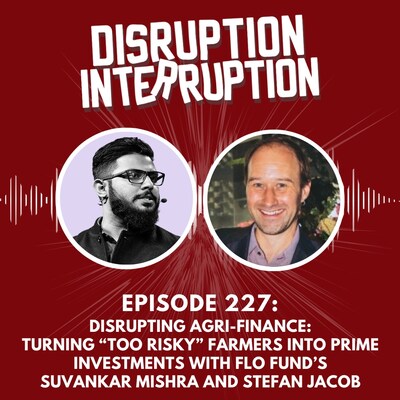
TAMPA BAY, Fla., April 30, 2026 /PRNewswire/ -- Traditional finance still treats smallholder farmers as a charity case when it should be treating them as a core part of the global economy. On this episode of Disruption Interruption, host Karla Jo Helms (KJ) speaks with Suvankar Mishra and Stefan Jacob, co-founders of FLO FUND, about why banks have failed farmers across the Global South, why value-chain financing is changing the landscape, and why food security in Europe and North America is directly tied to whether a farmer in Kenya or India can access a simple loan. As Mishra puts it, "We're not here to provide financing based on default behavior. We're here to provide financing based on integrity."
Why the Industry Still Gets Rural Risk Wrong
For Mishra and Jacob, the status quo is not just underfunding. It is a structural misunderstanding. Jacob describes a farmer in Kenya who could earn enough to support her family but never had enough money to fully plant her land, buy certified seed, or avoid selling to a middleman at unfavorable prices. "No bank would ever touch her," he says, even though her story is repeated "a million times across the global south."
That failure grows beyond a single season. With crop-linked credit running dry, farmers produce below capacity, accept dictated pricing, and remain exposed to medical shocks, education costs, and predatory lenders. Jacob notes that if a farmer takes a typical unsecured loan, the interest can be punitive, and the repayment schedule completely mismatched to the agricultural cycle. Mishra adds that earlier fintech attempts only made things worse by using alternative data to justify predatory monthly rates of five, six, or seven percent, then dressing it up as innovation. "That is not how it works," he says.
The deeper irony is that the rest of the world still depends on these same farmers. Mishra points out that most macadamia nuts consumed in Europe come from Kenya and that most of the world's cocoa comes from West Africa. If the Global North keeps underinvesting in people who grow food, he argues, the consequences will not stay local. They will show up in food scarcity, rising prices, weaker supply chains, and higher healthcare costs tied to a less stable and less nutritious food system.
FLO FUND's Bet: Finance the Value Chain, Not the Fear
Mishra and Jacob's answer is not another generic lending product. It is value-chain finance grown around the economics of agriculture. Rather than forcing farmers into banking models designed for salaried borrowers, FLO FUND integrates with processors, co-ops, agribusinesses, and digital agriculture ecosystems that know the farmer and already sit inside the crop cycle. As Jacob explains, "More and more farmers actually get the credit they need from their processor or their co-op, or someone who they're working with rather than a bank."
That model changes where the risk sits and how liquidity moves. FLO FUND finances not only the farmer's crop and inputs, but also parts of the downstream chain, including processors who may not have enough cash to pay farmers on time. "We clear the debt, so there's no debt sitting on the farmer," Jacob says. "Now all the risk sits with this processor." By injecting liquidity at multiple points, farmers are not trapped between middlemen, delayed payments, and debt that keeps compounding.
For Mishra, the longer-term opportunity is even bigger than crop lending. He sees FLO FUND as the seeding of a broader digital bridge: one that uses agricultural data, local infrastructure, and ethical scoring to create a more intelligent basis for financing rural communities over time. But the immediate mission is simpler and more urgent: prove that these farmers were never too risky to finance. The system failed to understand them. As Jacob puts it, "We know the solution works. What the market still lacks is not evidence, but enough people willing to take the leap."
Links
Disrupting Agri-Finance: Turning "Too Risky" Farmers into Prime Investments with FLO FUND's Suvankar Mishra and Stefan Jacob
Disruption Interruption is the podcast where you will hear from today's biggest Industry Disruptors. Learn what motivated them to bring about innovation and how they overcame opposition to adoption.
LinkedIn: https://www.linkedin.com/in/suvankarmishra/
https://www.linkedin.com/in/stefanjacob/
Company Website: https://flofund.co.za/
About Disruption Interruption™
Disruption is happening on an unprecedented scale, impacting all manner of industries — MedTech, Finance, IT, eCommerce, shipping, logistics, and more — and COVID has moved their timelines up a full decade or more. But WHO are these disruptors and when did they say, "THAT'S IT! I'VE HAD IT!"? Time to Disrupt and Interrupt with host Karla Jo "KJ" Helms, veteran communications disruptor. KJ interviews badasses who are disrupting their industries and altering economic networks that have become antiquated with an establishment resistant to progress. She delves into uncovering secrets from industry rebels and quiet revolutionaries that uncover common traits — and not-so-common — that are changing our economic markets… and lives. Visit the world's key pioneers that persist to success, despite arrows in their backs at www.disruption-interruption.com.
About Stefan Jacob
Stefan Jacob is an entrepreneur, corporate innovator, and advisor with experience building startups and innovation programs across the U.S., Europe, and Asia. His work has focused on using business and technology to solve real-world problems in emerging markets, with products spanning finance, retail, consumer goods, healthcare, and digital commerce. Before co-founding FLO FUND, he built innovation teams and startups, led product and go-to-market strategy, and worked as a management consultant on market expansion and turnaround projects. In the podcast, he explains that after more than a decade working across Asia on finance, insurance, and entrepreneurship, he reconnected with Suvankar Mishra to help build a more sustainable model for financial access in the Global South.
About Suvankar Mishra
Suvankar Mishra is an agri-finance entrepreneur focused on building "conscious capital businesses" at the intersection of agriculture, digital infrastructure, and financial inclusion. Before co-founding FLO FUND, he built EKUTIR, a Farming-as-a-Service platform that supported smallholder farmers across 10 countries in Asia and Africa, with a consistent focus on improving farmer productivity, incomes, and livelihoods through technology-enabled ecosystems. In the podcast, Mishra describes his path into the sector as a "leap of faith," shaped by early exposure to agricultural innovation and years of work in rural finance and microfinance. At FLO FUND, he is applying that experience to help close the financing gap for smallholder farmers by building value-chain lending models rooted in data, local ecosystems, and what he calls financing based on "integrity."
About Karla Jo Helms
Karla Jo Helms is the Chief Evangelist and Anti-PR® Strategist for JOTO PR Disruptors™. Karla Jo learned firsthand how unforgiving business can be when millions of dollars are on the line — and how the control of public opinion often determines whether one company is happily chosen, or another is brutally rejected. Being an alumnus of crisis management, Karla Jo has worked with litigation attorneys, private investigators, and the media to help restore companies of goodwill into the good graces of public opinion — Karla Jo operates on the ethic of getting it right the first time, not relying on second chances and doing what it takes to excel. Helms speaks globally on public relations, how the PR industry itself has lost its way, and how, in the right hands, corporations can harness the power of Anti-PR to drive markets and impact market perception.
References
- LIMRA, & Life Happens. (2024, April 15). U.S. life insurance need gap grows in 2024. limra.com/en/newsroom/news-releases/2024/u.s.-life-insurance-need-gap-grows-in-2024/
- LIMRA. (2026, March 3). Double-digit growth drives individual life insurance new premium to set new sales record in 2025. limra.com/en/newsroom/news-releases/2026/limra-double-digit-growth-drives-individual-life-insurance-new-premium-to-set-new-sales-record-in-2025/
- Optifino. (2025, September 29). Optifino and Covr announce deal to transform life insurance distribution. optifino.com/optifino-and-covr-announce-deal-to-transform-life-insurance-distribution/
Media Inquiries:
Karla Jo Helms
JOTO PR™
727-777-4629
 View original content to download multimedia:https://www.prnewswire.com/news-releases/disrupting-agri-finance-turning-too-risky-farmers-into-prime-investments-302759130.html
SOURCE Disruption Interruption