Before ChatGPT, PhyPal Had the Clinical Evidence but Not the AI. Now It's Back.
PR Newswire
SEATTLE, Oct. 9, 2026
Clinically studied patient engagement platform relaunches with conversational AI and a California workers' compensation pilot.
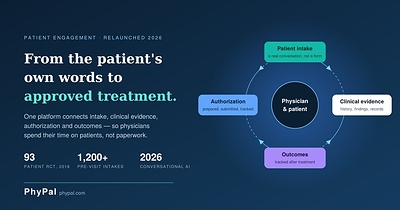
SEATTLE, Oct. 9, 2026 /PRNewswire/ -- PhyPal today announced the relaunch of its patient engagement platform, combining modern conversational AI with its original deterministic clinical technology. The updated platform connects patient intake, clinical documentation, outcomes tracking, and treatment authorization, with a pilot at a major California workers' compensation practice.
Founded in 2018 by Ranjeet Randhawa and the late Dr. Michael Brown, PhyPal developed Snapcare, a patient engagement system supported by a 93-patient randomized controlled trial published in the European Spine Journal. Patients using Snapcare alongside conventional care experienced significantly greater disability reduction at 12 weeks (p < 0.001).
Despite its clinical foundation, the technology faced a fundamental limitation: rule-based systems could follow structured pathways but struggled with unpredictable patient conversations.
"Michael used to describe patient conversations as peeling an onion," said Randhawa. "Layer by layer, until you understand what's really happening. We had the clinical foundation, but the technology couldn't sustain those conversations."
AI Changes What's Possible
PhyPal now combines large language models with deterministic clinical workflows, enabling natural patient conversations while maintaining structured controls over information collection and downstream processes.
More than 1,200 patients have completed pre-visit intakes using PhyPal's technology. The platform also supports after-visit summaries, longitudinal outcomes tracking, and authorization coordination.
"PhyPal has made collecting patient data faster and easier, so I can spend my time analyzing problems and communicating directly with patients," said Dr. Richard Jimenez, rheumatologist at Seattle Arthritis Clinic.
From Patient Conversation to Treatment Authorization
PhyPal's expanded capabilities connect patient histories and physician findings to authorization request preparation, submission, and tracking. Its California pilot will evaluate opportunities to reduce administrative work and improve treatment coordination.
"We didn't need AI to invent our clinical foundation," Randhawa said. "We needed AI to make that foundation accessible through natural conversation. Healthcare doesn't need another chatbot. It needs technology that connects what patients say with what providers need to do next."
About PhyPal
Founded in 2018, PhyPal develops AI-powered patient engagement and clinical workflow infrastructure, combining conversational intelligence with deterministic clinical processes.
Website: phypal.com
Clinical study: pubmed.ncbi.nlm.nih.gov/30324496
Media Contact
Ayumi Takasugi
8586050070
 View original content to download multimedia:https://www.prnewswire.com/news-releases/before-chatgpt-phypal-had-the-clinical-evidence-but-not-the-ai-now-its-back-302903504.html
SOURCE PhyPal