Lewes, Delaware, Aug. 17, 2026 (GLOBE NEWSWIRE) -- In its latest industry analysis, Verified Market Research® reports that the Global Amine-based Polyols Market Size was valued at USD 32.00 billion in 2025 and is projected to reach USD 45.51 billion by 2033, expanding at a compound annual growth rate (CAGR) of 4.5% over the 2025–2033 forecast period. The report, titled "Amine-based Polyols Market Size By Type (Polyether Polyols, Polyester Polyols), By Application (Rigid Foam, Flexible Foam, Coatings, Adhesives, Sealants, Elastomers), By End-User Industry (Construction, Automotive, Furniture & Bedding, Packaging), And Geographic Scope," covers five regions, three product types, six applications, four end-user industries, and more than ten key industry players, offering a comprehensive view of how the Amine-based Polyols Market is expected to evolve through the end of the decade.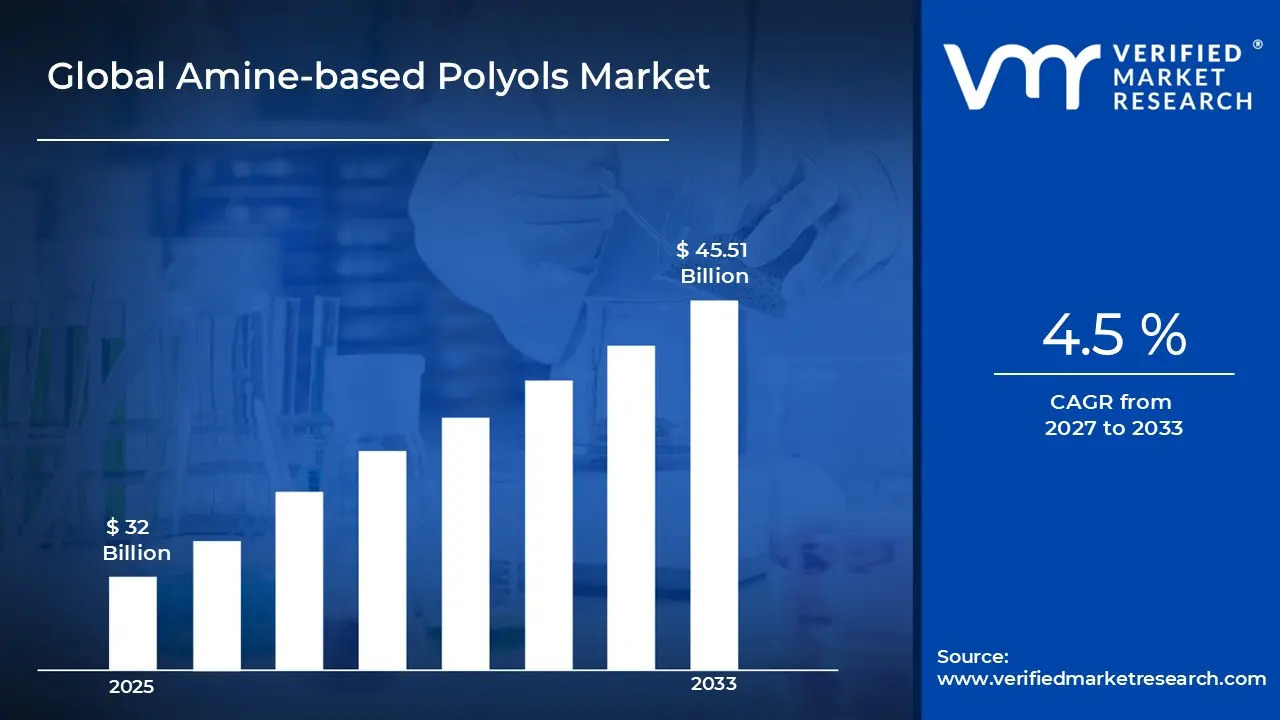 Download a free sample to access exclusive Insights, Data Charts, And Forecasts From Amine-based Polyols Market Sample Report
Amine-Based Polyols Market Overview: Scope, Definition, and Boundaries
The Amine-based Polyols Market encompasses the commercial production and supply of polyol intermediates whose chemical functionality is built around amine-derived architectures and reactivity pathways. These amine-based polyols function as multi-functional building blocks used to formulate polyurethane and related polymer systems, where the polyol component directly governs reactivity, crosslink density, performance characteristics, and processing behavior. Participation in the Global Amine-based Polyols Market is therefore defined by engagement in the value chain activities that manufacture these amine-based polyol inputs and by the commercial turnover of those inputs into downstream formulations and end-use applications.
Within the broader polymer and chemical ecosystem, the Amine-based Polyols Industry primarily functions to provide a controlled polyol substrate that enables specific material properties in finished products such as insulation materials, cushioning foams, protective coatings, bonding compounds, sealing formulations, and elastomeric systems. The market is scoped as an input market for performance-focused formulation systems rather than as a segment defined by the final product alone.
The report structures its inclusions around four analytical dimensions. By Type, the market covers Polyether Polyols and Polyester Polyols. By Application, it spans Rigid Foam, Flexible Foam, Coatings, Adhesives, Sealants, and Elastomers. By End-User Industry, it covers Construction, Automotive, Furniture & Bedding, and Packaging. Certain categories fall outside the defined scope of the Amine-based Polyols Market: amine-based compounds used solely as catalysts, blowing agents, crosslinkers, or chain extenders are excluded unless sold as the polyol substrate itself; polyurea-focused intermediates that do not rely on a polyol component are excluded because they occupy a different reaction system; and finished polymers, foam articles, coating films, or sealant products are excluded as standalone end products, since the market boundary remains fixed at the level of polyol material supply and specification.
Download a free sample to access exclusive Insights, Data Charts, And Forecasts From Amine-based Polyols Market Sample Report
Key Growth Drivers Fueling Amine-Based Polyols Market Growth
According to Verified Market Research®, Amine-based Polyols Market growth is driven by a cause-and-effect chain linking end-use performance demands to upstream polyol selection. Three primary drivers stand out in the report.
1. Low-Emission Formulation Requirements
As buyers and regulators tighten scrutiny on emissions and workplace exposure linked to polyurethane production and end use, formulators are prioritizing polyol chemistries that help achieve targeted performance profiles. This intensifies adoption across the Amine-based Polyols Market because these polyols support system-level properties such as reactivity balance, mechanical characteristics, and compatibility with existing polyurethane supply chains. As compliance becomes a purchasing gate, qualified products are seeing faster qualification cycles and repeat orders.
2. Construction Insulation Performance Targets
Buildings are increasingly required to meet higher thermal efficiency and tighter envelope specifications, translating into stronger rigid foam requirements. Amine-based polyols are used to tune foam formation behavior so insulation products meet dimensional stability and insulation performance expectations while maintaining workable processing windows. As energy codes and retrofit activity raise the volume of foam-grade polyurethane, demand is expanding through both new-build insulation and renovation programs, lifting consumption of amine-based polyols in rigid foam formulations.
3. Automotive Lightweighting and Mechanical Property Requirements
Vehicle platforms are shifting toward lighter structures with improved comfort, durability, and vibration control. These requirements favor polyurethane elastomers and flexible foam components where mechanical behavior must be engineered precisely. Amine-based polyols influence hardness, resilience, and formulation latitude, helping OEM supply chains select systems that meet design validation standards. As automotive production volumes and material qualification renewals move forward, elastomer and flexible foam demand continues to support steady Amine-based Polyols Market expansion.
Ecosystem-Level Drivers
Beyond these core drivers, broader ecosystem changes are enabling growth through operational and structural shifts in the polyurethane value chain. More dependable procurement of specialty inputs and improved distribution reliability for amine-based polyol grades reduce downtime during formulation trials and scale-up. Meanwhile, industry standardization of polyurethane performance testing is shortening qualification cycles across regions, and capacity expansion and consolidation among upstream chemical producers are improving consistency of supply a critical factor for applications such as insulation foams and automotive components that require steady throughput and predictable lot quality.
Emerging Opportunities in the Amine-Based Polyols Market
Verified Market Research® identifies several opportunity areas within the Amine-based Polyols Market Forecast that stakeholders can prioritize through 2033.
- Accelerating low-emission rigid foam adoption by scaling amine-based polyols for insulation formulations in energy retrofit programs, supported by procurement cycles that favor suppliers with documented formulation performance.
- Expanding flexible foam use in premium comfort and automotive interiors through tailored reactivity and improved durability, as OEM and brand owners tighten specification compliance.
- Unlocking higher-value coatings, adhesives, sealants, and elastomers by developing amine-based polyols for specialty performance niches such as adhesion, elasticity, weathering resistance, and controlled curing behavior.
At the ecosystem level, opportunities are also materializing through supply chain optimization, tighter formulation standardization, and better regulatory alignment for downstream product compliance. Producer investment in predictable feedstock and blending capabilities, more reliable storage and batch traceability, and partnerships with foam and chemical converters can all help new grades enter the Amine-based Polyols Market faster, supporting accelerated growth beyond the current base.
Download a free sample to access exclusive Insights, Data Charts, And Forecasts From Amine-based Polyols Market Sample Report
Market Challenges and Restraints
Despite favorable growth dynamics, the Amine-based Polyols Market Report identifies several restraints that could temper the pace of adoption.
- Substitution pressure from conventional polyols: Specification-driven procurement in foams, coatings, adhesives, and elastomers creates inertia against amine-based polyols, since changing chemistry requires requalification, stability testing, and updated safety documentation.
- Regulatory and compliance burdens: Amine-based chemistries require stricter controls for storage, exposure management, and waste handling, raising compliance scope for manufacturers and downstream formulators and increasing total project cost.
- Operational and supply-chain constraints: Capacity ramp-up limits and variability in upstream inputs can cause formulation drift and process stoppages, increasing safety stock requirements and reducing the likelihood of long-term volume commitments.
At the ecosystem level, fragmented supplier capabilities, limited standardization of formulation parameters, and uneven geographic compliance readiness reinforce these restraints. Supply chain bottlenecks can disrupt lead times and elevate working capital requirements, while inconsistent technical specifications complicate qualification across regions and applications.
Technology and Innovation Trends Shaping the Amine-Based Polyols Industry
Technology functions as the capability layer of the Amine-based Polyols Market, influencing how formulations are engineered, how efficiently plants convert feedstocks into polyol intermediates, and how reliably end users can translate those materials into foam, coatings, adhesives, sealants, and elastomers. The report highlights three key innovation areas.
- Reactivity and formulation window stabilization: Innovation is narrowing variability between polyol lots so formulators can maintain predictable cure behavior, improving line reliability for automotive and construction supply chains that require strict output consistency.
- Process efficiency improvements: Manufacturing methods that improve throughput and reduce sensitivity to operating conditions lower the incidence of off-spec material and improve equipment utilization, supporting more predictable supply across foams, coatings, and elastomers.
- System-level compatibility design: For non-foam applications, innovation targets how amine-based polyols integrate into formulation systems that must meet film formation, adhesion behavior, and network durability trade-offs, enabling more straightforward qualification for coatings and elastomers used in transportation, consumer products, and packaging.
The report also notes several market-wide trend statements: formulation control is shifting toward more standardized polyol architectures to improve reproducibility across foam systems; application segmentation is becoming more granular as converters adopt dedicated system formulations for coatings, adhesives, sealants, and elastomers; polyether and polyester polyols are being positioned for clearer fit-for-purpose roles, reducing cross-application substitution; technical qualification is moving upstream in the supply chain; and distribution and relationship models are consolidating around specification-led ordering, lowering reliance on broad stocking.
Industry Use Cases and End-User Applications
The Amine-based Polyols Market Analysis outlines distinct, end-use-defined processing routes that translate chemistry into product performance across construction, automotive, furniture and bedding, and packaging value chains.
Insulation Core Fabrication for Building Envelopes
Amine-based polyols are used in rigid foam formulations where insulation panels or in-situ injected insulation must meet thermal and mechanical expectations in real building assemblies. Manufacturing environments require consistent metering, controlled reaction exotherm, and stable expansion behavior to avoid density variation across large board formats or complex geometries. This drives demand through specification-led purchasing and recurring consumption in new construction and refurbishment cycles.
Polyurethane Elastomer Components for Automotive Durability
In automotive production ecosystems, elastomer-relevant formulations that rely on amine-based polyols are used for components where repeated deformation and wear resistance are critical. These systems require consistent rheology for molding or casting and are validated through performance testing related to vibration, temperature exposure, and mechanical fatigue. Demand is shaped by qualification cycles, repeat orders from OEM and tier suppliers, and the need for formulation stability under production throughput constraints.
Protective and Functional Coating Layers
Amine-based polyols appear in coatings where film formation, adhesion, and curing behavior determine whether a surface meets scratch resistance, weatherability, or chemical resistance requirements. These formulations must perform across heterogeneous substrates such as metals, composites, or treated surfaces while meeting uniformity and adhesion-strength criteria, driving ongoing demand in production programs where formulation consistency directly influences downstream rejection rates.
End-User Industry Segment Applications
- Construction: Prioritizes insulation and installation performance, reinforcing demand for application systems that tolerate variable jobsite conditions.
- Automotive: Centers on qualification and repeatability under manufacturing and testing regimes, affecting how formulations are selected and adjusted for reliability.
- Furniture & Bedding: Reflects comfort-oriented processing requirements and consistent output across production batches.
- Packaging: Aligns with the need for barrier, sealing, or functional performance in constrained conversion workflows.
Download a free sample to access exclusive Insights, Data Charts, And Forecasts From Amine-based Polyols Market Sample Report
Regional Outlook: Global Amine-Based Polyols Market
The Amine-based Polyols Market exhibits clear geographic differences in demand maturity, end-use priorities, and formulation constraints. North America and Europe show more mature adoption patterns, driven by established manufacturing bases and tighter product performance expectations. Asia Pacific is shaped by industrial scale-up and construction and automotive production growth. Latin America reflects a mid-stage profile, while the Middle East & Africa shows demand linked to infrastructure development and expanding industrial production capacity.
North America
In North America, the Amine-based Polyols Market behaves as a technology-led and compliance-sensitive segment. Demand is pulled by concentrated end-user ecosystems in construction materials, especially rigid foam insulation, automotive components and interior foams, and specialty chemical use in coatings, adhesives, sealants, and elastomers. The region benefits from a mature industrial infrastructure and an innovation ecosystem spanning chemical manufacturers, formulators, and equipment suppliers, supporting faster iteration on performance targets across foam and specialty applications through 2033. Compliance-driven formulation behavior, capital availability tied to manufacturing modernization cycles, and supply chain maturity further support steadier demand patterns across the region.
Europe
Europe's demand for the Amine-based Polyols Market is shaped by regulatory discipline, material traceability expectations, and a comparatively mature industrial base. Harmonized EU frameworks across chemicals, product safety, and environmental performance set the boundary conditions for formulation choices, influencing which amine-based polyols can be used in rigid foam, flexible foam, coatings, and elastomers. The region's cross-border manufacturing network increases sensitivity to compliance documentation and consistent supply specifications, favoring quality-controlled production routes and incremental innovation over abrupt formulation changes. Public policy and institutional procurement tied to energy efficiency and building standards further stabilize demand for qualified suppliers.
Asia Pacific
Asia Pacific leads the Global Amine-based Polyols Market with approximately 45% share, driven by construction and automotive consumption growth. The region is shaped by expansion-led industrialization, with demand increasing alongside construction activity, manufacturing capacity, and consumer-market growth. Japan and Australia exhibit more mature consumption patterns and technology-driven procurement cycles, while India and much of Southeast Asia show faster scaling of chemical transformation and downstream converting industries. Rapid urbanization and large population centers expand the addressable base for rigid and flexible foam, coatings, and sealant applications, while dense manufacturing ecosystems reduce input logistics costs and support localized supply for end-use plants.
Latin America
Latin America represents an emerging segment within the Amine-based Polyols Market, with adoption expanding unevenly across Brazil, Mexico, and Argentina. Demand is supported by construction activity, automotive production cycles, and incremental growth in foam-based applications, though penetration is closely tied to broader macroeconomic conditions. Economic volatility and currency fluctuations affect buyer purchasing power and working-capital planning, which can delay specification changes and reorder timing, while infrastructure gaps and logistics frictions outside major industrial corridors further shape the pace of adoption.
Middle East & Africa
The Middle East & Africa region presents a selectively developing pattern in the Amine-based Polyols Market, where demand expands in concentrated pockets rather than broad-based maturity across all geographies. Gulf economies shape regional consumption through construction-led modernization and petrochemical-linked industrial programs, while South Africa and select North African markets influence baseline uptake in furniture, coatings, and industrial packaging applications. Infrastructure gaps, logistics constraints, and import dependence for polyol inputs differentiate how quickly rigid foam, flexible foam, and elastomeric use cases can scale across the region.
Download a free sample to access exclusive Insights, Data Charts, And Forecasts From Amine-based Polyols Market Sample Report
Competitive Landscape: Leading Amine-Based Polyols Market Players
The Amine-based Polyols Market displays a balanced competitive structure where neither pure scale advantages nor complete fragmentation dominate. Competition is primarily shaped by performance requirements in end-use formulations and by compliance obligations tied to chemical safety, labor practices, and evolving regulatory expectations for polyurethanes. Firms compete across four levers: chemistry performance in reactivity and compatibility with polyol blends; process control that improves consistency from pilot to commercial production; formulation support and technical service that shorten qualification cycles; and distribution reach that reduces logistics friction for customers with multi-site production footprints. BASF SE leads the competitive landscape due to its integrated feedstock supply, application support, and batch consistency.
BASF SE
BASF SE functions as a broad-scope chemical supplier and systems-enabler for polyurethane and related formulation chemistries. Its positioning is tied to integration across upstream chemicals, formulation know-how, and the ability to supply consistent batches that reduce variability risk for customers, with differentiation most visible in technical collaboration and formulation support that helps manufacturers tune reactivity, foam performance, and end-product properties.
Covestro AG
Covestro AG plays a technology-driven integrator role, oriented toward high-performance polymer material solutions used in foams and specialty polyurethane systems. Its differentiation is reflected in application alignment for polyurethane segments where performance consistency is critical, including rigid insulation and flexible applications requiring tuned physical properties.
Dow Inc.
Dow Inc. commonly positions as a global supplier with strong process engineering capabilities and customer-facing technical support, enabling predictable performance in polyurethane feed systems. Its competitive behavior is closely linked to reliability and breadth of chemical expertise, supporting multi-site customers seeking stable supply and consistent formulation outcomes.
Huntsman Corporation
Huntsman Corporation operates with a specialty and performance-focused posture, emphasizing tailored solutions and responsive technical collaboration, particularly relevant in coatings-related polyurethane systems and elastomer-oriented performance requirements.
Evonik Industries AG
Evonik Industries AG contributes through materials science and specialty chemistry capabilities that support performance and compliance-relevant documentation in polymer applications, influencing reactivity behavior, compatibility, and the properties of foams, coatings, and elastomeric systems.
Beyond these profiled players, the broader competitive set includes Wanhua Chemical Group Co., Ltd., Mitsui Chemicals, Inc., Stepan Company, Perstorp Holding AB, and LANXESS AG. These companies influence the market through complementary positioning, including regional scale advantages, supply responsiveness, and specialized polyurethane-related chemistry or application alignment for coatings, sealants, adhesives, and elastomer systems. Collectively, this group supports competitive diversity across geographies and end-use applications, helping prevent a simple shift toward uniform pricing power.
Download a free sample to access exclusive Insights, Data Charts, And Forecasts From Amine-based Polyols Market Sample Report
Amine-Based Polyols Market Segmentation
By Type
- Polyether Polyols
- Polyester Polyols
By Application
- Rigid Foam
- Flexible Foam
- Coatings
- Adhesives
- Sealants
- Elastomers
By End-User Industry
- Construction
- Automotive
- Furniture & Bedding
- Packaging
By Geography
- North America
- Europe
- Asia Pacific
- Latin America
- Middle East & Africa
Strategic Outlook Through 2033
Verified Market Research® expects the Amine-based Polyols Market to continue its expansion-and-normalization cycle through 2033, with sustained demand supported by ongoing refurbishment, infrastructure activity, and manufacturing upgrades rather than purely cyclical consumption. Growth is expected to be distributed across construction-driven insulation demand and automotive-led performance requirements, with packaging and furniture contributing steady consumption linked to durability and throughput needs.
The report indicates that competitive intensity in the Amine-based Polyols Market Forecast will likely evolve toward greater specialization in application-tailored chemistry and deeper customer integration for qualification and compliance documentation, rather than rapid consolidation. Investment focus areas identified in the report point to continued capital absorption into plant optimization, formulation improvements, and customer qualification cycles for rigid foam, flexible foam, and high-performance application categories such as coatings, adhesives, sealants, and elastomers supporting steadier demand capture across construction and automotive end markets where performance requirements and sustainability specifications tend to be roadmap-driven.
Overall, stakeholders evaluating the Global Amine-based Polyols Market are advised to prioritize application qualification readiness and formulation capability, since segment-level momentum is likely to follow where downstream specifications evolve fastest across construction, automotive, furniture and bedding, and packaging end-use verticals through the 2033 forecast horizon.
Related Reports
Global Polyether Polyols For CASE Market Size By Application (Coatings, Adhesives, Sealants, Foams, Elastic Products), By Component Structure (Polyether Polyols With Hydroxyl Values, Polyether Polyols With Various Functionalities, Polyether Polyols With Low Viscosity, Polyether Polyols With High Reactivity), By Geographic Scope and Forecast
Global Green and Bio Polyol Market Size By Type (Polyether Polyols, Polyester Polyols), By Application (Furniture and Bedding, Construction, Automotive, Packaging, Carpet Backing), By Raw Material (Natural Oils and Their Derivatives, Sucrose, Glycerin, Carbon Dioxide), By Geographic Scope And Forecast
Global Aliphatic Polyester Polyols Market Size By Product Type (Adipate Polyols, Caprolactone Polyols), By Application (Coatings, Adhesives And Sealants, Elastomers), By End-Use Industry (Construction, Automotive, Furniture And Bedding, Electronics), By Geographic Scope And Forecast
Global Polyurethane Elastomers Market Size By Raw Material (Isocyanates, Polyols), By Application (Wires and Cables, Conveyor Belt, Rollers), By End-User Industry (Automotive Industry, Food and Beverage Industry, Packaging Industry, Aerospace and Aviation Industry), Geographic Scope and Forecast
Top Redispersible Polymer Powder Manufacturers driving modern construction innovation
Visualize Amine-based Polyols Market using Verified Market Intelligence -:
Verified Market Intelligence is our BI Enabled Platform for narrative storytelling in this market. VMI offers in-depth forecasted trends and accurate Insights on over 20,000+ emerging & niche markets, helping you make critical revenue-impacting decisions for a brilliant future.
VMI provides a holistic overview and global competitive landscape with respect to Region, Country, Segment, and Key players of your market. Present your Market Report & findings with an inbuilt presentation feature saving over 70% of your time and resources for Investor, Sales & Marketing, R&D, and Product Development pitches. VMI enables data delivery In Excel and Interactive PDF formats with over 15+ Key Market Indicators for your market.
About Us
Verified Market Research® stands at the forefront as a global leader in Research and Consulting, offering unparalleled analytical research solutions that empower organizations with the insights needed for critical business decisions. Celebrating 10+ years of service, VMR has been instrumental in providing founders and companies with precise, up-to-date research data.
With a team of 500+ Analysts and subject matter experts, VMR leverages internationally recognized research methodologies for data collection and analyses, covering over 15,000 high impact and niche markets. This robust team ensures data integrity and offers insights that are both informative and actionable, tailored to the strategic needs of businesses across various industries.
VMR's domain expertise is recognized across 14 key industries, including Semiconductor & Electronics, Healthcare & Pharmaceuticals, Energy, Technology, Automobiles, Defense, Mining, Manufacturing, Retail, and Agriculture & Food. In-depth market analysis cover over 52 countries, with advanced data collection methods and sophisticated research techniques being utilized. This approach allows for actionable insights to be furnished by seasoned analysts, equipping clients with the essential knowledge necessary for critical revenue decisions across these varied and vital industries.
Verified Market Research® is also a member of ESOMAR, an organization renowned for setting the benchmark in ethical and professional standards in market research. This affiliation highlights VMR's dedication to conducting research with integrity and reliability, ensuring that the insights offered are not only valuable but also ethically sourced and respected worldwide.
Follow Us On: LinkedIn | Twitter | Threads | Instagram | Facebook

Mr. Edwyne Fernandes

Verified Market Research®

US: +1 (650)-781-4080

US Toll Free: +1 (800)-782-1768

Email: sales@verifiedmarketresearch.com

Web: https://www.verifiedmarketresearch.com/

SOURCE – Verified Market Research®